Can You Explain What Happened?
Communication skills for teens go beyond essays. Learn why giving context, answering the actual question, listening, and asking for help are essential to adulthood.
Ask a teenager what happened and you may get a perfectly accurate answer that tells you almost nothing. They know the context. You don't. The missing details are the whole problem.
Communication isn't just writing a decent essay. It's knowing what another person needs to understand, saying it clearly, listening to the response, and trying again when the message doesn't land. That becomes important when the person across from you is a doctor, an employer, a landlord, or someone you've hurt.
I want young adults who can read difficult material, write a useful message, explain a problem without leaving out the essentials, and disagree fairly. Being polished is optional. Being understandable isn't.
What communication actually asks of you
Real life will not ask whether they can label a sentence diagram. It will ask whether they can explain what happened, state what they need, ask a useful question, read the message carefully, document the problem, and respond without making the situation worse.
It will ask whether they can talk to the doctor when something feels wrong, email the teacher or boss when there is a problem, tell a friend the truth without turning cruel, apologize without turning the apology into a defense brief, and keep trying when the first version of the conversation is muddy.
The everyday version
Communication practice starts earlier than we usually admit. It starts when a kid comes to you with a problem and can’t explain the context.
They’re upset, or frustrated, or rushed, or annoyed that you don’t instantly understand what they mean. So they start in the middle. They leave out the setup. They assume you already know what happened before you walked into the room. They give you feelings instead of facts.
They say, “He did it again,” as if you know who “he” is, what “it” means, and what happened the last three times.
That’s not just a parenting annoyance. That’s communication practice.
A kid who can’t explain the context can’t get useful help. A kid who rambles around the point may have a real problem, but they’re making it harder to solve. A kid who can’t slow down and clarify what they mean is still depending on someone else to do the invisible work for them.
We don’t always count that as learning. We count the essay, the spelling test, the presentation, the report. But we don’t always count the moment a kid has to stop, back up, explain the situation, name the actual problem, and say what they’re asking for.
We should.
That may matter more in adult life than another five-paragraph essay.
Say what you mean
One of the most basic communication skills is also one of the hardest: say what you mean. Not what you’re circling around, not the emotional weather around the thing, not the ten details that feel important because you’re upset. The thing.
What happened? What do you need? What have you already tried? What are you asking me to do? What are you afraid will happen? What part don’t you understand?
And just as important: answer the question being asked.
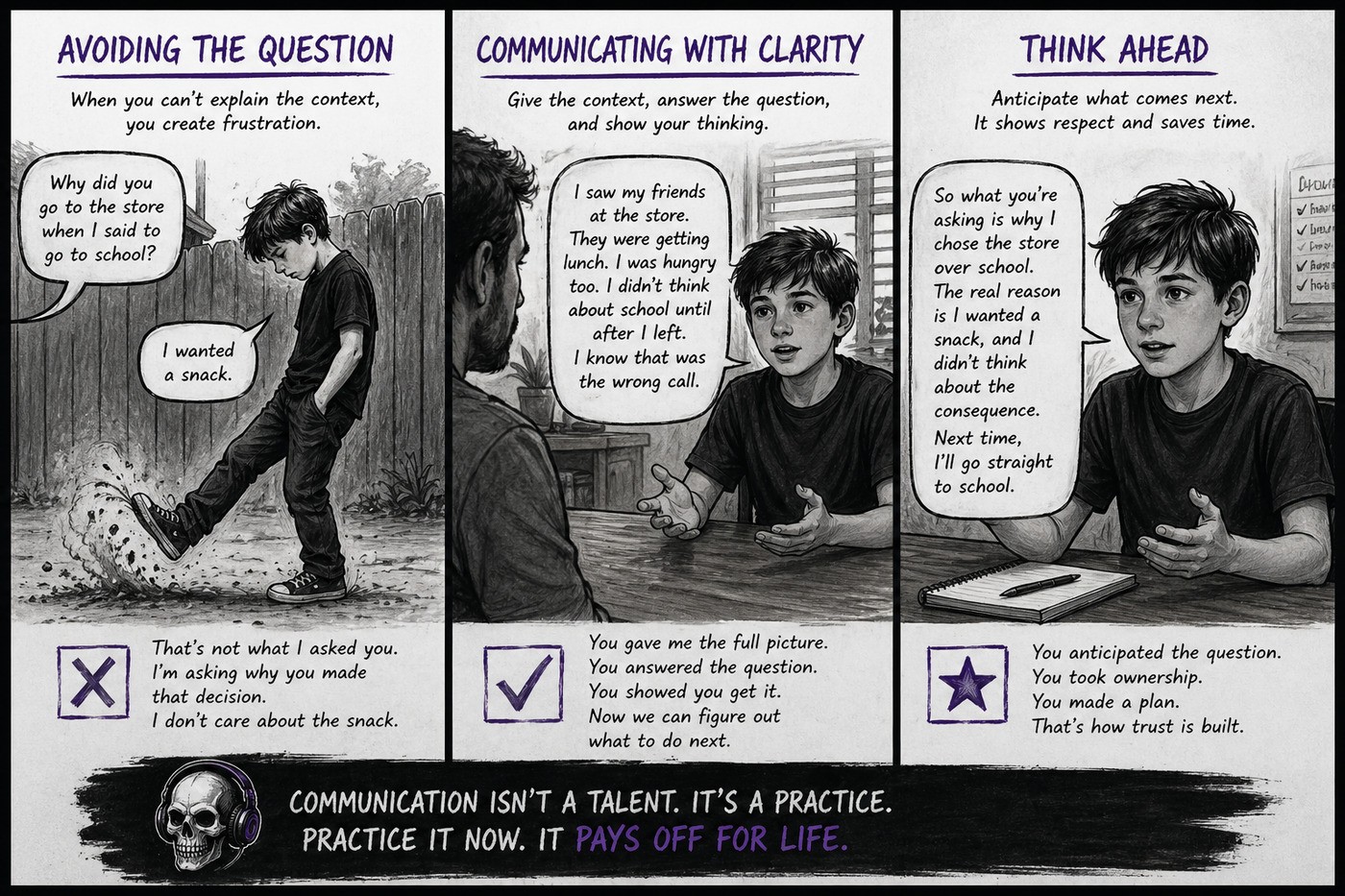
Kids are very good at answering the question next to the question. Ask, “Why did you go to the store when I told you to go to school?” and you get, “I wanted a snack.”
That is not an answer.
The snack explains what they wanted. It doesn’t explain why they made that decision — why they ignored the instruction, changed the plan, and decided what they wanted mattered more in that moment. The real question was never about the snack, and they usually know that.
Adult life is full of this. A boss asks why the work is late. A roommate asks why the bill wasn’t paid. A doctor asks when the symptoms started. A friend asks why you didn’t show up. A partner asks why you said yes when you meant no.
If the answer dodges the real question, communication has failed.
A young adult needs to learn to hear what’s actually being asked, anticipate the next obvious question, and stop pretending that a technically related answer is the same as an honest answer.
That’s not a school skill. That’s adulthood.
When being understood matters
A floor-complete 18-year-old doesn’t need to be eloquent. They don’t need to write like a professional, win debates, enjoy public speaking, or come across as charming, extroverted, and quick on their feet.
But they do need to function.
At minimum, they should be able to explain what they need, ask a useful question, write a clear email or message, make a phone call when the situation requires it, read instructions carefully, summarize what someone else said, tell the truth without burying the main point, apologize without turning it into self-defense, disagree without immediately escalating, document a problem, communicate with adults outside the family, and keep trying when the first attempt doesn’t work.
They should also be able to give context. By 18, a young adult should be able to walk into a conversation and explain the situation well enough that another person can understand the problem:
Here’s what happened.
Here’s what I need.
Here’s what I tried.
Here’s where I’m stuck.
Here’s what I’m asking.
They should be able to answer the question being asked, not dodge into a nearby fact that feels safer.
That’s the floor. Not polish. Function.
A young adult who can do those things isn’t finished. Nobody is. But they’re not helpless. They can enter a new situation, gather information, state a need, respond to feedback, and keep moving.
Beyond the floor
The floor isn’t the ceiling. Beyond the minimum, communication becomes one of the main ways a person builds a life. Writing gets stronger, speech gets clearer, listening gets deeper, humor gets sharper. Conflict gets less childish. Storytelling becomes possible. Persuasion becomes honest instead of manipulative. Emotional honesty gets more precise.
A young adult who grows beyond the floor can do more than get by. They can make a case, explain an idea, write something worth reading, teach someone else, negotiate, lead a hard conversation, say no without turning cruel, say yes without disappearing into people-pleasing, repair trust after they damage it, and use language to build instead of just react.
That’s the deeper hope of the Communication Domain: not a kid who sounds impressive, but a person who can create clarity, connection, and forward motion.
Where it gets tested
Communication isn’t mostly tested in essays. It’s tested when a kid comes downstairs furious and expects everybody else to understand the whole situation from one sentence. When they ask for help but skip the part where they explain what they’ve already tried. When they’re blaming somebody else but haven’t told the story in a way that separates facts from feelings. When they’re embarrassed and want the adult to rescue them without making them explain the problem.
Later, it’s tested when the doctor says something confusing and they have to ask a follow-up question. When a debit card gets declined. When a deadline is missed. When a roommate keeps leaving dishes in the sink. When a boss gives unclear instructions. When a friend is hurt. When a landlord sends a confusing lease. When a form asks a question they don’t understand. When the first sentence in their mouth would make everything worse.
Academic writing can help. Done well, it teaches structure, evidence, clarity, and revision. But life asks for more than thesis statements and paragraph structure. It asks: what happened, what matters, what needs to be said, who needs to hear it, what format fits, what can wait, what needs to be documented, what’s the cleanest true sentence, and what am I avoiding?
That’s communication as adult competence.
Clarity is not polish
This isn’t about turning children into miniature executives. It’s not about making every kid debate, or grammar as a personality, or forcing shy kids to become extroverts, or correcting every sentence until the kid stops wanting to talk.
And it’s not about letting kids spray words everywhere and calling it self-expression. Expression matters, but communication is more than self-expression. It also takes accuracy, timing, listening, repair, restraint, courage, and responsibility. A person can express themselves constantly and still communicate badly. They can talk a lot and still not say what they mean.
The goal isn’t more talking. The goal is better contact with reality and other people.
Practice the hard conversations
The Communication Domain doesn’t require turning the house into school. It requires real communication to be treated as real.
That means you don’t always accept the first muddy version. You make them try again. You help them slow down, ask for the missing context, separate the story from the complaint, name the request, notice when they’re rambling, answer the actual question, and think about what someone will obviously ask next. You work with them until the meaning is actually on the table.
This can sound small. It isn’t. A child who learns to clarify their own meaning is learning how to think, how to ask for help, and how to participate in adult life without making everybody else guess.
The daily opportunities are everywhere. Let the kid order food. Let them ask the librarian, email the coach, explain the problem, make the call, write the note, apologize directly, sit with the awkward pause, and try again when the first version was muddy.
Then close the loop. What worked? What was unclear? What sentence would have helped? What did the other person need that we didn’t give them? What should we do differently next time?
That’s not assignment theater. That’s life being used on purpose.
At six, that might mean asking the server for ketchup. At ten, explaining a problem to a teacher. At thirteen, writing a clear message about a group project. At sixteen, making an appointment, asking for clarification at work, or handling a disagreement without hiding behind a parent.
By eighteen, the pattern should be clear: this person can communicate well enough to function outside the family.
Not perfectly. For real.
When the stakes are real
The real test of Domain 1 isn’t whether a young adult can produce a clean essay on command. The real test is whether they can use language when the stakes are no longer academic.
Can they understand, be understood, solve problems, build relationships, repair damage, navigate systems, and take responsibility for their own life? Can they slow down, start over, tell what happened, name what they need, answer the question, and say what they mean?
That is Domain 1. Not essays. Not speeches. Not polish.
Communication as adult capability.
What conversation has taught you about helping a young person explain something difficult? Send your experience or objection. The examples that challenge this argument are often the most useful.