What Are You Really Agreeing To?
Financial literacy for teens is more than vocabulary: it means reading contracts, comparing debt, recognizing incentives, and making money decisions that preserve options.
The most expensive financial decisions often come dressed up as manageable monthly payments. A lease, a phone plan, a car loan, a credit card, or a job offer can look simple until you read what happens after you agree.
Young people need more than the vocabulary of economics and personal finance. They need to work through numbers, read documents carefully, recognize incentives, and ask who benefits from the terms on offer. Sometimes the right choice is to sign. Sometimes it's to walk away. Either way, they should understand the trade.
Money decisions also shape the options available later. Interest, taxes, wages, risk, and opportunity cost aren't abstractions when they affect where you can live, which work you can turn down, and how quickly one bad decision can become a long obligation.
Where financial decisions get made
By 18, the floor is supposed to be built. Real life will ask whether they can decide if they should sign a lease they can barely afford, take on loans they do not fully understand yet, accept a job that pays less but gets them out of a bad situation, send money to someone who keeps asking, or use a buy-now-pay-later button for something they do not actually need.
It will ask whether they can read the money behind the decision: what it costs now, what it costs later, who benefits if they say yes, what they give up, and whether the paperwork hides the part that matters. None of that is the school worksheet. All of it is the actual job.
School finance stops at definitions
School finance teaches definitions; real life asks questions. It teaches the names of accounts, taxes, and documents without the judgment those things require — so a student can pass the personal finance unit, get an A, and still sign a lease without reading it.
It teaches inflation as a definition and capitalism as a debate topic, but not how to look at a paycheck, a bill, or a contract and ask what is actually happening.
The problem isn't that schools don't cover the material. The problem is that the material as covered is inert. A student can know what compound interest is and still not understand what their student loan is going to do to them over ten years. A student can define "opportunity cost" on a test and never apply it to a real decision.
Know what to read, and how to get it read
The standard advice in this space is: read everything you sign. It's the right instinct and the wrong instruction.
A young adult is going to encounter a mountain of paperwork in adult life. Most of it is throwaway: the Apple terms of service, the cookie banner, the click-through software license, the privacy policy nobody has ever read. Nobody is going to start reading those, and a domain that asks them to gets ignored.
The real skill is knowing which paperwork actually matters and making sure those documents get read — even if not by them alone.
Leases, loan papers, employment contracts, insurance policies, anything that takes their money or their time on a recurring basis. These get read. By them, by a parent, by a lawyer, by a friend who knows the field, or with an AI tool used only to surface the questions they should be asking.
A young adult in this decade can paste a lease into an AI tool and ask, "what should I be asking about this?" That isn't cheating — it is a floor-level move, as long as the tool raises questions, not conclusions, and the person still checks, asks, and decides. Same goes for comparing loan terms or decoding insurance language.
The kid who doesn't read anything is easy to steamroll. The kid who reads everything quits. The kid who knows what matters and how to get help on the rest is hard to fool.
Money skills worth demonstrating
The floor isn't being rich. The floor isn't picking the right stock. The floor isn't a thirty-year financial plan. The floor isn't macroeconomic theory.
The floor is enough capability to make their own money decisions without being run by debt, salespeople, appetite, or paperwork they didn't understand.
They can run their own money — track what they spend, save toward something they want, avoid the obvious traps, and explain what credit is and what it costs. They can recognize the documents that matter — leases, loans, contracts, insurance, tax forms — and make sure those get read, by them or by someone or something that helps them ask better questions.
They understand taxes and basic insurance well enough not to get blindsided by obligations, coverage, or claims. They understand how markets work: supply and demand, prices as signals, why things cost what they cost. They can think about value beyond money — time, opportunity cost, what they trade when they choose.
They understand that economic systems and the institutions inside them are designed, have tradeoffs, and serve different interests. No system is neutral.
Not perfection. Not professional polish. Just enough capability that they can walk into adult life and make their own calls.
Opportunity cost is the real price tag
A young adult who can only see the dollar price of a thing is making half-blind decisions. The real price is what they gave up to have it.
Money is one part. Time is another. A second job earns more money and costs the evenings. A cheaper apartment saves money and costs an hour each way on the road. A degree opens some doors and closes others while it's being earned.
Opportunity cost is the move that turns a money decision into a real decision.
It's also the thing that makes them harder to manipulate. Someone selling a "great deal" is showing the dollar number. They aren't showing what gets traded for it. The kid who asks "what am I giving up to do this?" doesn't get sold things they don't need.
What does this company make money on?
This is the single most useful question in adult financial life.
The bank, the lender, the insurance company, the brokerage, the employer, the landlord, the financial advisor, the car dealer. None of them are evil. All of them are designed. They make money on something. That something shapes everything they recommend.
An insurance company makes money on premiums collected versus claims paid. That affects which claims get fought. A financial advisor paid on commission makes money on transactions. A financial advisor paid by the hour makes money on time. Those two people give very different advice about the same situation.
A car dealer makes money on the financing more than the car. That's why the conversation always drifts to monthly payments.
None of this requires cynicism. The kid doesn't have to think anyone is out to get them. They just have to ask the question before they take the recommendation. What does the person across the table make money on? And how does that shape what they're telling me to do?
That question is the entire difference between being a customer and being a target.
What financial competence is not
This isn't a lesson about getting rich. The floor doesn't require wealth or any particular relationship to ambition. A kid who hits the floor can choose a quiet life, a low-paying meaningful job, or any other path. The point isn't the size of the pile. The point is the ability to handle the pile that exists.
It also is not investment advice, legal advice, tax advice, or a claim that an AI tool can decide what a young adult should sign. This domain teaches the questions: what does this cost, who benefits, what am I agreeing to, what help do I need, and what am I giving up?
And this isn't a lesson about refusing to engage with money on moral grounds.
Some young people decide money is crass, that finance is dirty, or that paying attention to it is beneath them. That posture works until the rent is due. Then it stops working, and they get steamrolled by the systems they refused to learn.
Refusing to engage isn't principle. It's unpreparedness wearing a costume.
What money handled well buys
Money handled well buys time. Money handled well buys options. Money handled well buys distance from people and situations that aren't good for them.
That's what the floor is actually for. Not a number in an account. The ability to walk away from a bad job, a bad relationship, a bad apartment, or a bad deal — because their finances don't have them trapped.
That's the quiet payoff of doing this domain right. Not wealth. Freedom of movement.
Let young people see real decisions
Most of this domain gets built in the regular flow of family life, not in lessons.
Give them money to manage early. Real money. Then don't bail them out when they spend it badly. The lesson lives in the bad month, not in the lecture. The point is to let discomfort teach. Not to manufacture catastrophe. A blown allowance is a teacher. An eviction notice is not.
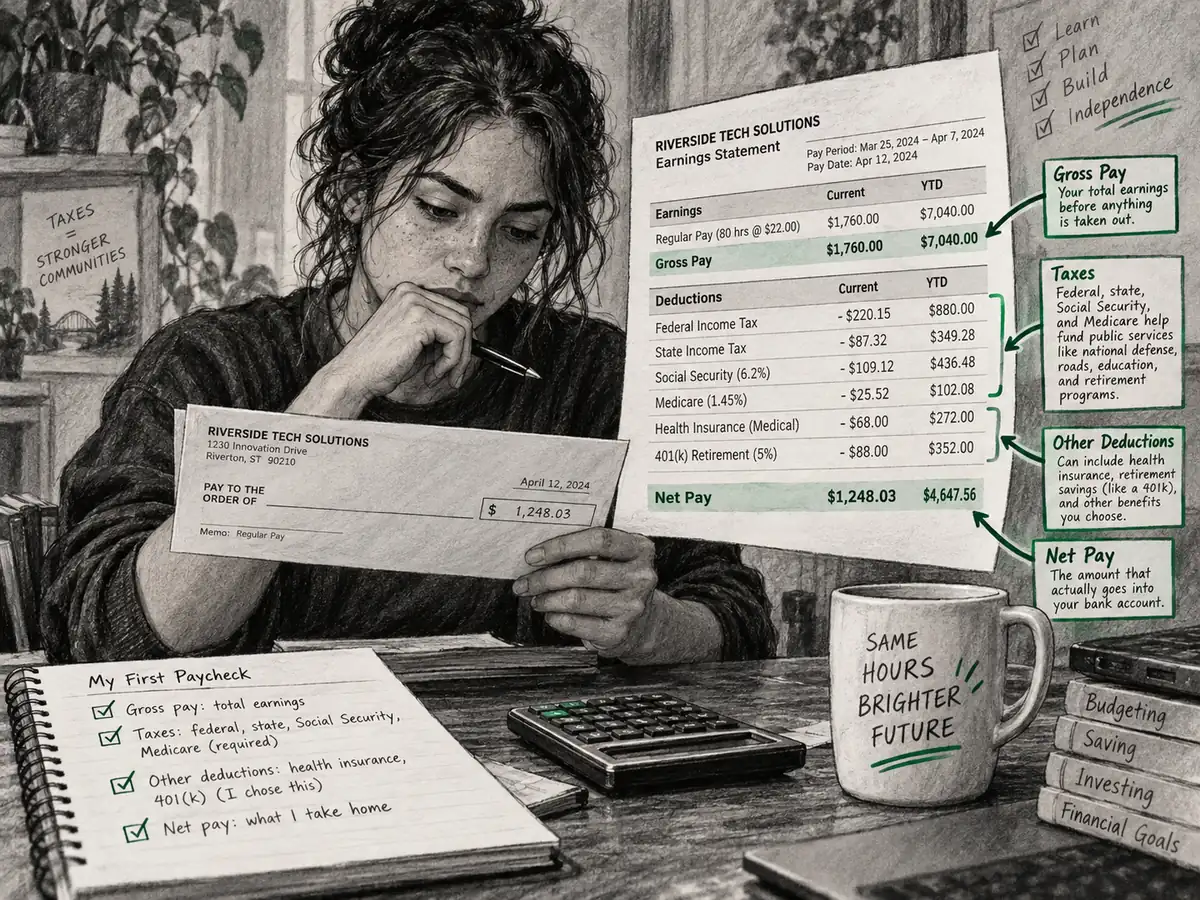
Let them see your paycheck, your bills, and your taxes when they're old enough to handle the information. Every family has different things they can show without making the kid carry adult anxiety. Some honest light on family finances goes a long way.
When they want something expensive, ask what they would give up to have it. If a bill arrives that's wrong, have them call. Have them ask the questions. Have them push back. The first real adult financial skill is the willingness to disagree with paperwork.
When they have their first job, have them file their own taxes. Even if it's simple. Especially if it's simple. Before they sign anything — a phone contract, a gym membership, a payment plan — have them figure out which parts matter and either read those or get help reading them.
Show them the tools. Open a brokerage account together and let them buy an index fund with a small amount; let them try a budgeting app. They'll learn what investing actually is by doing it, not by hearing about it.
When they travel, give them a budget to manage. Let them figure out the currency, the cards, the costs.
Talk about money the way you'd talk about anything else. Not as a taboo. Not as a fight. As a normal part of running a life.
Build the capability slowly over years, without it ever looking like school.
Read before you agree
Can they look at a paycheck and tell you what got taken out and why? Can they spot which parts of a lease actually matter, and either read those carefully or know who to ask? Can they tell the difference between a good deal and a deal someone in a suit told them was good?
Can they say no to a thing they want, without making the no into a performance? Can they tell you, out loud, what they gave up to do what they're doing? Can they use the tools available to surface better questions about things they can't read alone? Can they ask "who benefits if I say yes?" before they say yes?
Not balanced checkbooks. Not memorized terms. Not picking the right stock. Economics and finance as the ability to handle their own money without getting steamrolled.
Which money decision do you wish someone had helped you understand before you signed? Send your experience or objection. The examples that challenge this argument are often the most useful.