Make Something. Finish It.
Creative confidence grows through practice, revision, criticism, and finishing. Creativity is a real-world skill, not a label assigned to talented children.
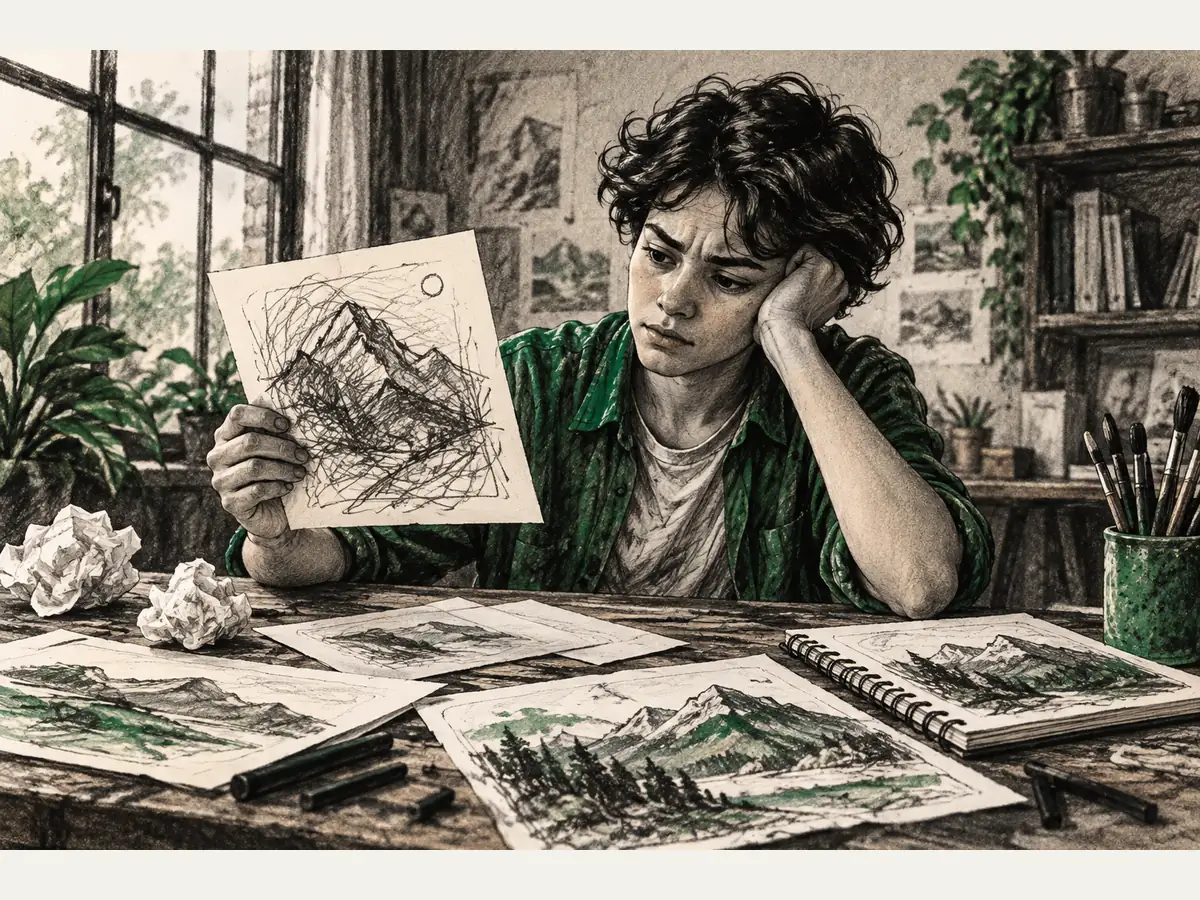
A child draws something, decides it isn't any good, and stops. Another keeps changing the drawing until it says what they wanted to say. The difference isn't always talent. Often it's whether someone has learned that an imperfect first attempt is part of making anything.
Creativity includes music, writing, visual art, design, building, performance, and the ordinary work of finding a new way through a problem. It takes ideas, but it also takes tools, practice, criticism, revision, and finishing. None of those requires a child to have been labeled gifted.
I want young people to have creative outlets they care about, to develop judgment about their work, and to know what it feels like to carry an idea past the exciting beginning and into an actual finished thing.
Why making things matters
By 18, the floor is supposed to be built. Real life will ask whether they can make something from nothing when there is no example to copy, finish what they start, and keep going when the first rough version is worse than the idea in their head.
It will ask whether they can solve a problem nobody solved for them, design the room, fix the workflow, name the thing, plan the event, make a case people can actually hear, process something hard by making something out of it, and keep one creative outlet alive because making is good for them.
That's the actual class. Not a grade on a still-life. Not a semester of recorder. Not whether they were "the creative one" in the family. The actual class is whether they can make things and finish them.
When children decide they aren't creative
School mostly handles creativity by sorting.
Art, music, and drama get treated as electives — nice if there is room, first to go when budgets get tight. Inside those classes, kids get sorted fast. The ones who show early ability get called talented and pushed forward. The ones who do not get a passing grade and a quiet message: this isn't your thing.
By middle school, most kids have already decided whether they are creative or not. That decision usually has nothing to do with practice and everything to do with who happened to be ahead at age nine.
The problem isn't that creative work gets judged. It should. Craft is real, and a kid who never gets honest feedback never improves. The problem is the order. School judges the performance before a kid has built any identity as someone who makes things — graded first, maker second.
So the kids on the wrong side of that early sorting quietly learn that creativity is a thing you fail, and stop.
It runs backwards. The making has to come first. The same honest standard lands fine on a kid who already believes the making is theirs to do — and crushes a kid who doesn't.
What creative competence looks like
The floor is not artistic mastery. It is not a polished portfolio. It is not formal training. It is not talent. It is not being good at any particular art form.
The floor is a working relationship with making things — enough that a young adult can create, finish, and use creativity as a real tool instead of believing it belongs to other people.
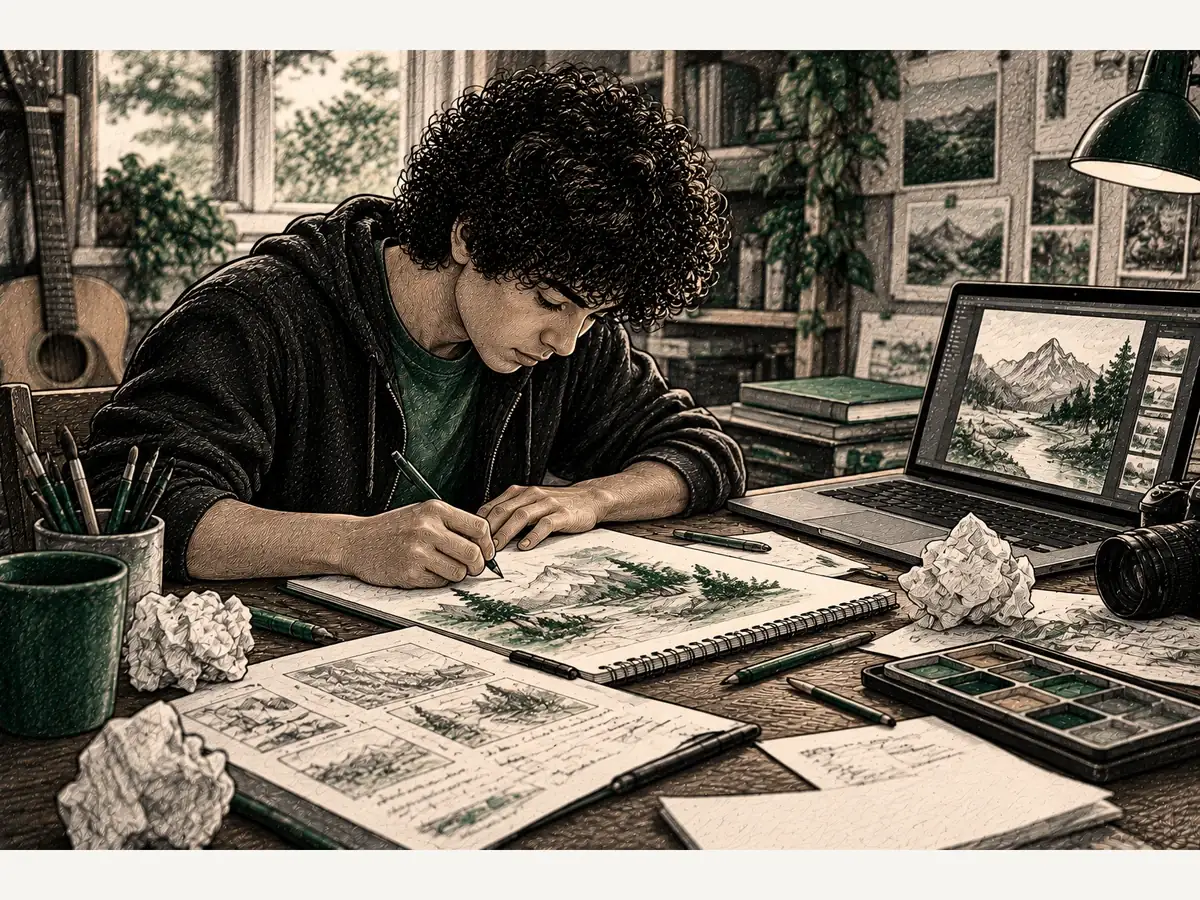
By 18, they should be able to make something that didn't exist before, in any medium, without waiting for permission or an assignment. They should be able to finish and improve creative work, not just start it. A first draft is not a finished thing, and a kid who only ever starts hasn't learned the actual skill.
They should be able to use creative work as a tool — to process something, communicate something, or work an idea out — not just for a grade or a wall. They should be able to push through the discomfort of making something that might not be good, and to let it be seen — by a parent, a small group, a teacher, whoever the work is for.
Creative risk gets real when the thing leaves your head and meets another person.
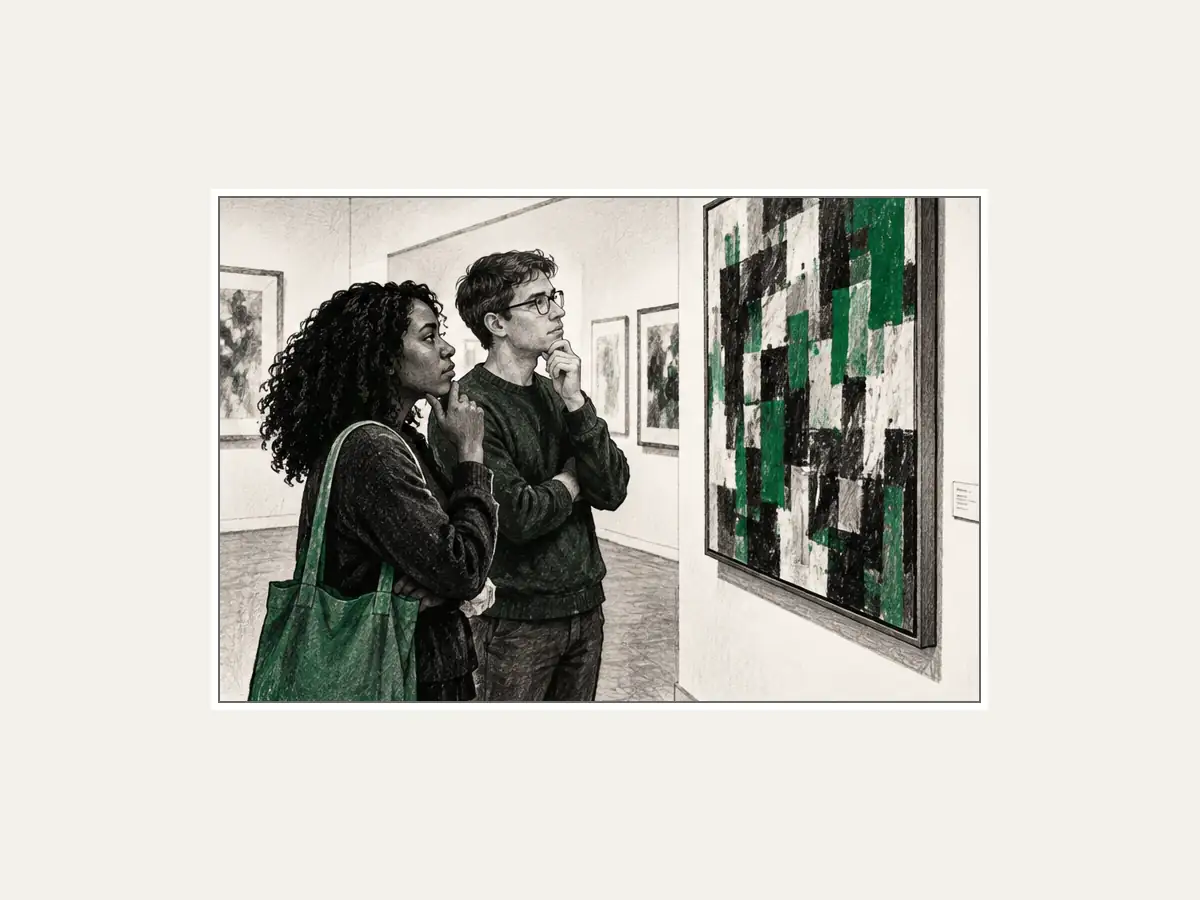
They should be able to appreciate creative work across cultures and forms, even when it is not their taste, and say something true about what is working in it and why. They should be able to tell the difference between "I don't like this" and "this isn't good." Taste and craft are not the same thing, and confusing them makes a person both a worse maker and a worse critic.
They should know, from experience, at least one creative outlet that feels satisfying — something they make because making it is good, and can pick back up when they choose. And they should understand that creativity is a skill that develops, not a fixed trait.
That single belief is the difference between a person who keeps making things and a person who quit at nine.
That's the floor. Not mastery. A practiced relationship with making.
Talent is not the whole story
"I'm just not creative" sounds like humility. It's actually a permission slip to stop trying.
The belief survives because it is convenient: it explains away every hard moment. Aptitude is real — some people pick things up faster — but aptitude is not destiny, and nobody is born knowing how to draw, write, play, build, or compose.
The people who are good at those things practiced, usually for years, usually badly at first, usually while someone else assumed they were just gifted. The talent everyone admires is mostly the visible tip of a lot of invisible bad work.
A kid who thinks creativity is a fixed trait stops the moment something is hard, reads the difficulty as proof they don't have it, and never gets to the part where it gets good.
A kid who thinks creativity is a skill treats the same difficulty as normal. Of course the first attempts are rough. That's what first attempts are.
The goal is not to convince every kid they are an artist. The goal is to make sure no kid mistakes a slow start for a closed door.
Finishing changes the work
Starting is easy. Everybody starts.
Finishing is where most creative work dies — and finishing is the part that actually teaches.
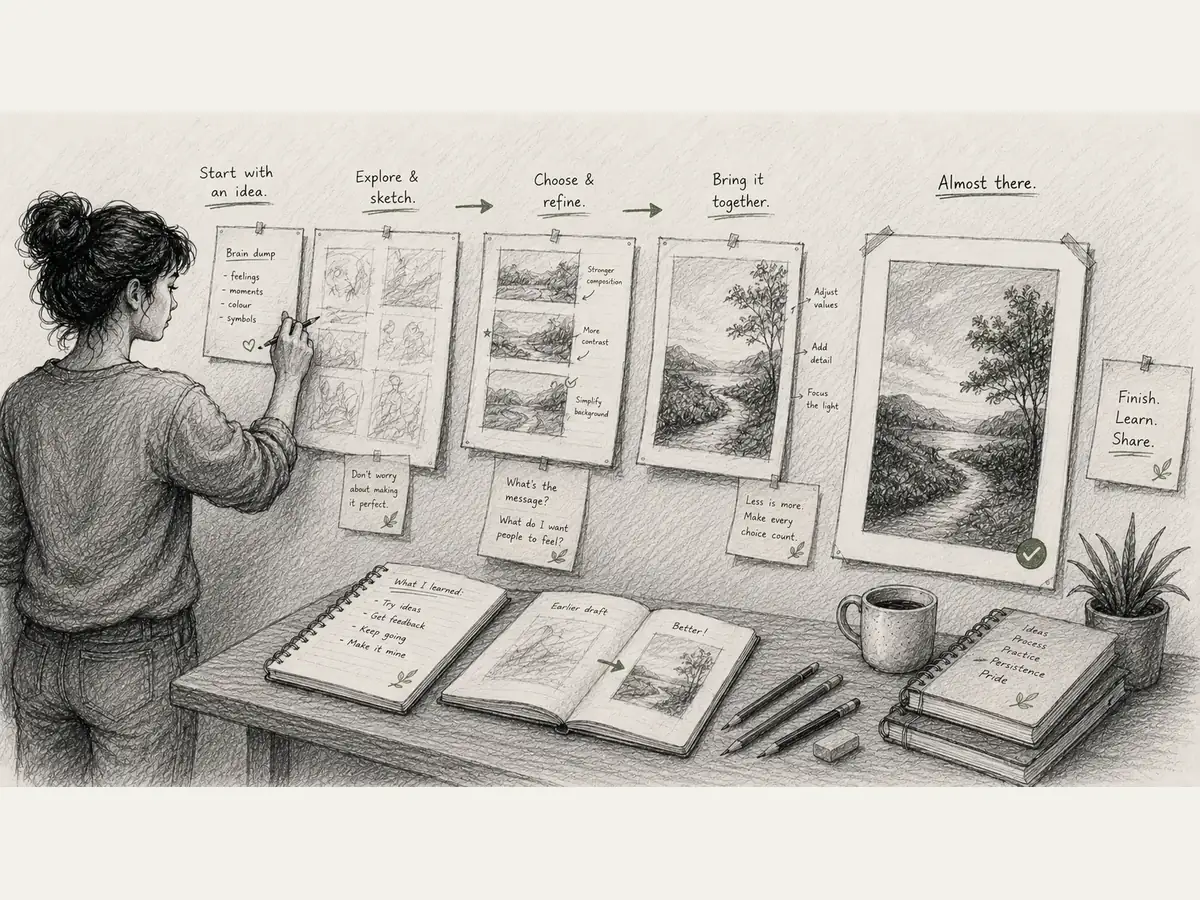
The first draft, the rough sketch, the demo recording: that is the fun part, where the idea is still perfect because it is not real yet. The work begins when you have to look at the real, flawed version of your idea and keep going anyway.
That's where the skill lives. Revising something that is not working. Cutting the part you loved because it does not serve the whole. Sitting with the gap between what you imagined and what you actually made, and closing it instead of abandoning it.
A kid who only ever starts learns nothing except how to start. A kid who finishes — even badly, even small — learns how making actually works: idea, attempt, mess, revision, done.
It also means tolerating the risk that the thing might be bad. Every finished thing is a bet that you had something worth making — sometimes a private bet, sometimes one other people get to see. A kid who can't stand that vulnerability will stay safe and make nothing.
Finish things. Imperfect, small, embarrassing things. Finishing is the rep.
Taste is not the same as quality
Two different skills hide inside "being good at art," and most people only develop one. The first is making. The second is judging — and a young adult needs to be honest about the difference between "I don't like this" and "this isn't good."
They are not the same. You can hate opera and still hear the discipline, range, and control in it. You can love a dumb pop song and still know it is not doing anything special. Disliking something masterful and enjoying something lazy is allowed. Taste is allowed.
The problem starts when someone treats their preference as a verdict on quality, or writes off an entire form because it is not to their taste.
A floor-level adult can look at work outside their own taste — a genre they do not enjoy, a tradition they did not grow up in, a style that is not theirs — and still say something true about what is working in it and why.
That's not pretension. It's the basic respect of judging a thing on its own terms instead of on whether it flattered them.
This cuts both ways. It keeps a person from being a snob who confuses unfamiliar with bad. And it keeps them from being a pushover who can't tell craft from junk because "it's all subjective anyway."
It's not all subjective. Taste is personal. Craft is real. A young adult should be able to hold both.
Creativity is a tool, not decoration
Creativity is a way of solving problems that do not have a known answer. The person who can turn an idea into something real is the one who designs the workaround, reframes the argument so people finally hear it, or builds the thing the instructions did not cover.
None of that has to be called art. All of it uses the same muscle.
It's also a way of handling what is inside you. People write, play, draw, and build to process grief, confusion, anger, and joy they can't get at any other way. A young adult with no creative outlet has one fewer way to deal with being human.
That's the real cost of giving up on this domain. It's not just giving up drawing. It's giving up a whole class of tools — for solving problems, for communicating, for getting through hard things — and handing them to "creative people," as if those were a separate species.
What creativity doesn't require
This is not about making artists. It is not about talent, and it is not about turning every kid into a content creator chasing an audience.
It is not about pretending craft does not matter because "all art is valid," and it is not about pretending effort alone equals quality. Finishing a thing and finishing a good thing are different, and a kid eventually needs to feel that difference.
And it is not about forcing every kid into the same medium, the same style, or someone else's idea of what counts as creative.
Making is for everyone. That doesn't mean everyone makes the same thing.
Make room for practice and revision
Families don't need to run an art school. They need to keep making a normal, expected, no-big-deal part of life — and stop sorting kids into creative and not.
Make things in front of them. Cook, build, fix, write, draw, play something badly. Let them see an adult be a beginner without shame. The kid who watches a parent make bad pancakes and laugh learns more about creative risk than any class teaches.
Give them materials and time, and mostly stay out of the way. Not a project with a rubric — just stuff, and room to use it. But help them scope it small enough to actually finish. A kid who sets out to write a novel quits; a kid who finishes a one-page story learns the whole loop. Small and done beats big and abandoned.
Praise the finishing, not the talent. "You stuck with that" builds a maker. "You're so talented" builds a kid who is afraid to try the hard thing in case it proves them wrong.
When they make something, ask about it instead of rating it. What were you going for? What is the part you would change? Curiosity keeps them making. A score makes them stop.
Expose them to work outside their taste — music, film, art, writing from other cultures and eras — and talk about what is working in it, not just whether you liked it.
Let them be bad at things. Protect the early, ugly, unimpressive stage, because that is the stage everything good comes through.
And don't let "I'm not creative" stand. Not from them, not from yourself. It's not a fact. It's a habit they can still break.
Make something, finish it, try again
The real test of Domain 8 isn't whether a young adult got an A in art.
It's whether they can create something real, finish it, use it to communicate or solve or process, and keep making when the first version is bad.
Do they understand, in their bones, that creativity is a skill they can build — not a trait they were or weren't given?
I don't want a child deciding at nine that making things is for somebody else.
What helped a young person you know keep making things after the first attempt fell short? Tell me what you've seen. Examples that challenge this argument are welcome.