Being Good With Your Phone Isn't Enough
Digital, media, and AI literacy for teens means evaluating online claims, protecting personal data, using AI without surrendering judgment, and controlling attention.
A teenager can navigate a phone faster than I can and still struggle to recognize a scam, check a source, manage an account securely, or explain how an AI tool reached its answer. Familiarity with an interface is not the same as understanding the system behind it.
Digital literacy has several jobs. We need young people who can use technology to make and solve things, identify manipulation and misinformation, protect themselves and others, and understand when convenience comes with a cost in privacy or attention.
AI makes the distinction especially important. A useful tool can help someone ask better questions, practice, compare possibilities, and complete real work. It can also produce confident errors or substitute for thinking that the learner still needs to do. Knowing when to trust, check, reject, or simply stop using the tool is part of being competent.
What digital competence means in practice
By 18, the floor is supposed to be built. Real life will ask whether they can learn a new app, system, or device without someone walking them through every click; get useful work out of an AI tool without handing over their own thinking; spot a scam, phishing message, fake source, or deal designed to rob them; and protect their accounts, money, identity, and reputation from people who do this for a living.
It will ask whether they can tell a reliable source from a confident stranger, notice when they are being sealed inside an echo chamber, feel a feed pulling on them and put it down anyway, troubleshoot the frozen laptop or dead connection before calling for help, and still function when the power is out, the phone is dead, or the tool they normally use is unavailable.
That's the actual class. Not a typing test. Not a slideshow about cyberbullying. Not whether they can find a video faster than you can. The actual class is whether they run the technology or it runs them.
Using a phone isn't the same as understanding technology
The phrase "digital native" was supposed to describe a generation comfortable with technology. In practice it became an excuse for adults to stop teaching.
If kids are just naturally good at this, the logic goes, there is nothing to teach. The grown-ups, who did not grow up with smartphones, decide they are the ones who do not get it, and hand the whole subject over to the children.
That's exactly backwards.
Growing up with a tool is not the same as understanding it. A kid raised in a car does not automatically know how the engine works, how to spot a mechanic ripping them off, or how to drive safely on ice. They just know how to sit in the back seat and be taken places.
That's most kids and technology. Expert passengers. Helpless drivers.
The comfort is real, and it is worth something — they aren't scared of a new device, and that matters. But comfort without understanding is exactly what scammers, platforms, and algorithms are built to exploit. A confident user who does not know what is happening under the surface is the easiest person in the world to manipulate.
The job isn't to make them comfortable. They're already comfortable. The job is to make them hard to fool — and expensive to manipulate.
Skills worth demonstrating
The floor is not coding. It is not building apps. It is not being "the tech person." It is not staying current on every new platform that launches.
The floor is enough competence, skepticism, and self-control that a young adult uses technology as a tool instead of being used by it.
By 18, they should be able to use technology to get real things done — not dependent on it, not afraid of it, just competent. They should be able to learn a new app, platform, or device on their own. Find the settings, read the documentation, search the error message, ask the right question. The specific tool will change a hundred times in their life. The ability to walk up to an unfamiliar one and figure it out is the actual skill.
They should be able to work with AI without outsourcing their thinking to it — knowing what these tools are good at, where they fail, and how to use them to do more rather than to avoid doing anything.
They should be able to protect themselves online: manage passwords, recognize scams and phishing, and understand what data they are handing over and to whom. This is not paranoia. It's the digital version of locking your door.
They should be able to control their own attention, and to evaluate information — trace a claim to its source, cross-check it, and notice when they are being fed exactly what keeps them scrolling.
They should be able to troubleshoot basic problems before calling for help, and understand that technology is built by humans with agendas — it is not neutral, and it is not inevitable.
They should be able to function without it when they have to. A young adult who falls apart when the phone dies or the power goes out has built their competence on a foundation that can vanish in a storm.
And they should be able to use digital tools to make something real — a document, a spreadsheet, a video, a design, a working project that serves an actual purpose, not just a grade.
That's the floor. Not coding. Command instead of dependence.
Use AI without handing over your judgment
This is the fastest-moving part of the domain, which is exactly why the principle has to be durable.
AI tools are genuinely useful. They can draft, summarize, explain, translate, brainstorm, and tutor. A young adult who refuses to touch them out of fear is choosing to be slower and less capable than they need to be.
But there is a trap, and it is a deep one.
These tools will do the thinking for you if you let them — and they make it feel like progress. You get an answer. It sounds good. The work appears done. What is missing is the part where your own brain actually got stronger, because it did not have to do anything.
The skill is using AI to think better, not to think less.
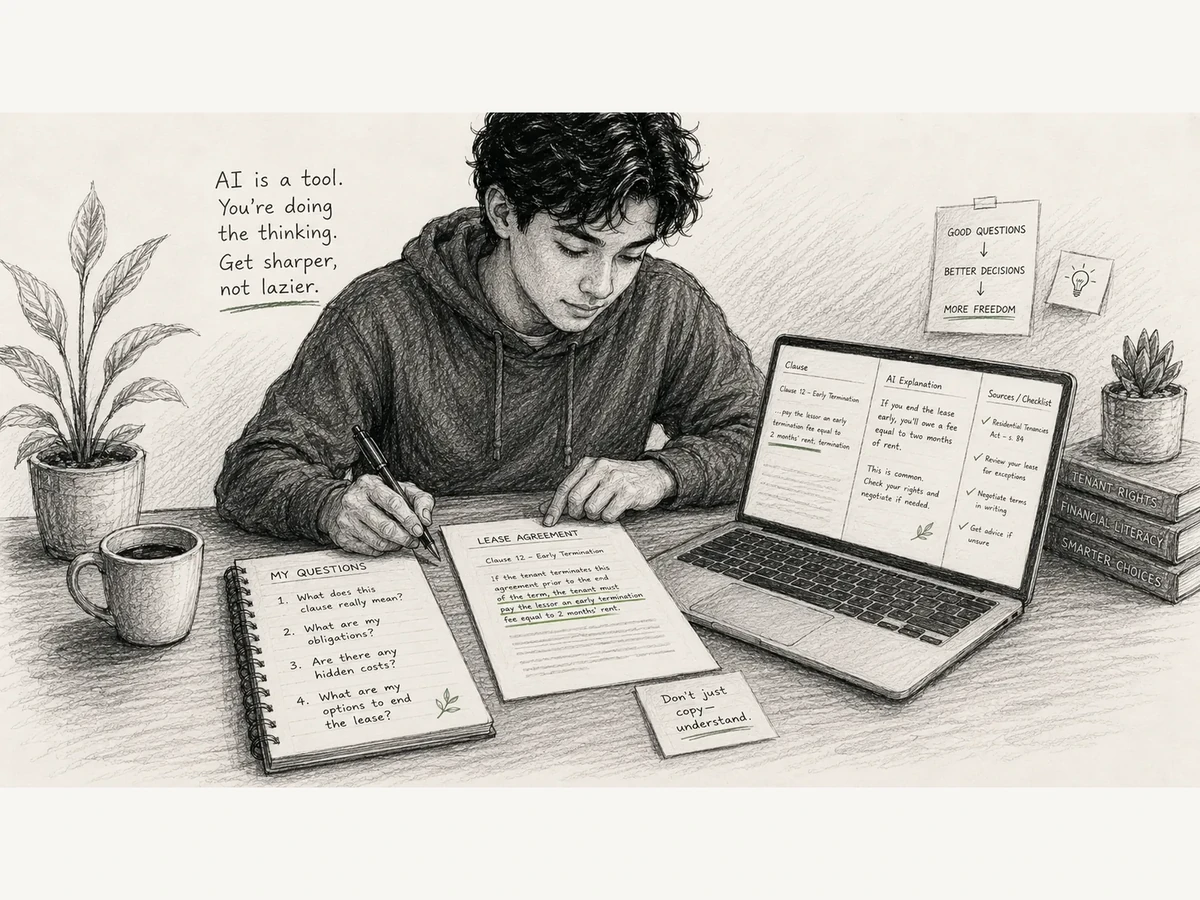
Use it to check your reasoning, not replace it. To explain the thing you don't understand, then make sure you actually understand it. To draft the version you then tear apart and rebuild in your own words. To handle the boring parts so you can do the parts that matter.
Make it concrete: a young adult facing their first lease can use an AI tool to translate a confusing clause into better questions for the landlord, a parent, or a qualified professional. The tool does not decide whether to sign. It makes the person more informed before they ask, check, and decide. That is the whole difference.
This also means knowing how these tools fail. They make things up with total confidence. They get facts wrong, invent sources, and agree with whatever you seem to want to hear. A young adult who trusts AI output without checking it is going to get burned, repeatedly, in ways they may not even notice.
The test is simple: after using an AI tool, are you smarter or just finished? If you are smarter, it was a tool. If you are just finished, it was a crutch — and crutches, used long enough, make the leg stop working.
Search results are not evidence by themselves
A young adult needs to understand what kind of place the internet actually is. It is not a neutral collection of information waiting to be looked up. It is a designed environment where some of what you find is true, some is wrong, some is bait, and some was built specifically to provoke a reaction.
The information and the manipulation arrive through the same screen, in the same format, looking equally trustworthy.
The old skill was finding information. There was not enough of it, so the trick was access. That skill is no longer the hard part. There is now infinitely more information than anyone can use, most of it free, much of it garbage.
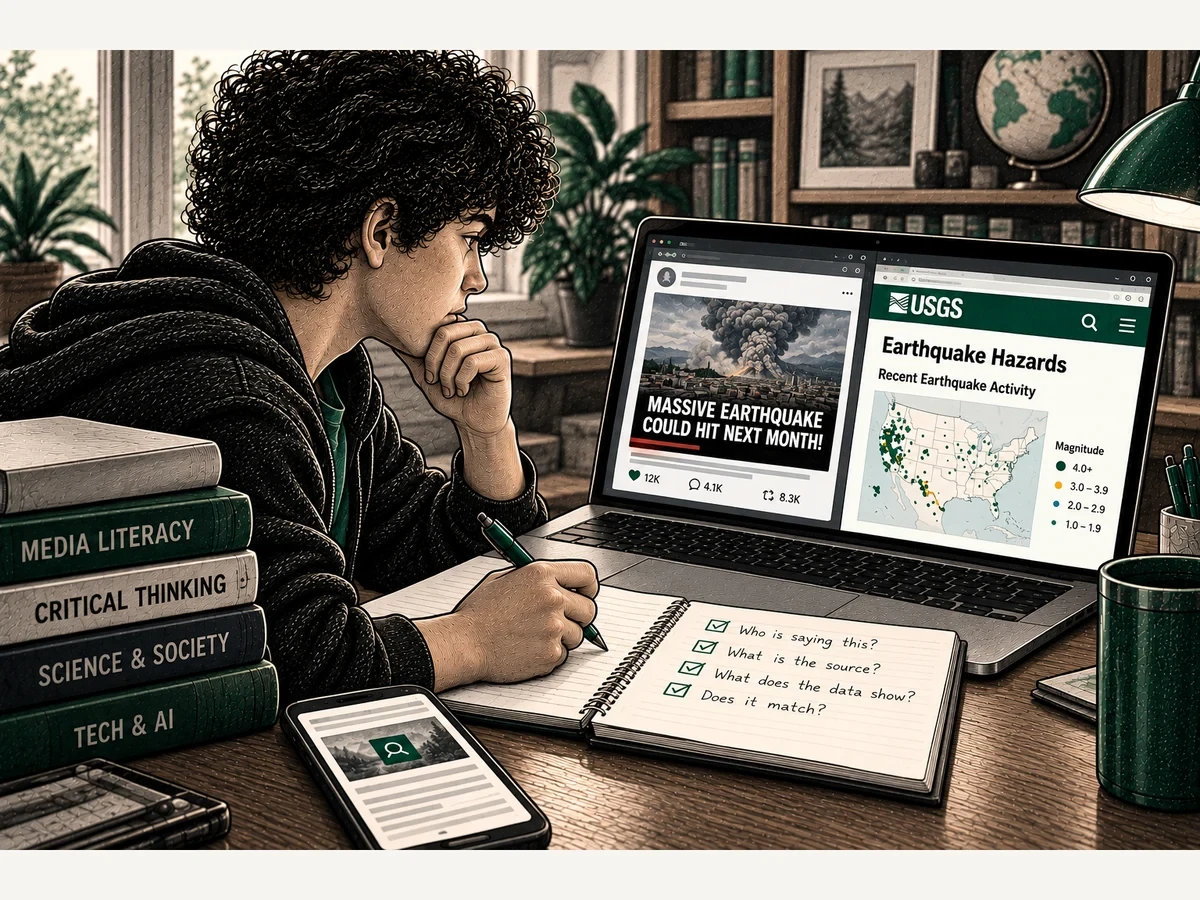
The new skill is the opposite: filtering. Out of the flood, what is actually true? Who said it, and how would they know? What is missing? What is this trying to make me feel, and who benefits if I feel it?
This is where echo chambers live. A young adult who only ever sees the version of the world that confirms what they already believe will mistake their feed for reality and never notice the walls.
The fix is not to find the one true source. It is a working reflex: trace it, cross-check it, and stay suspicious of anything that arrives perfectly designed to confirm what they already think.
Who controls your attention?
The most important fight in this domain is not about information. It is about attention.
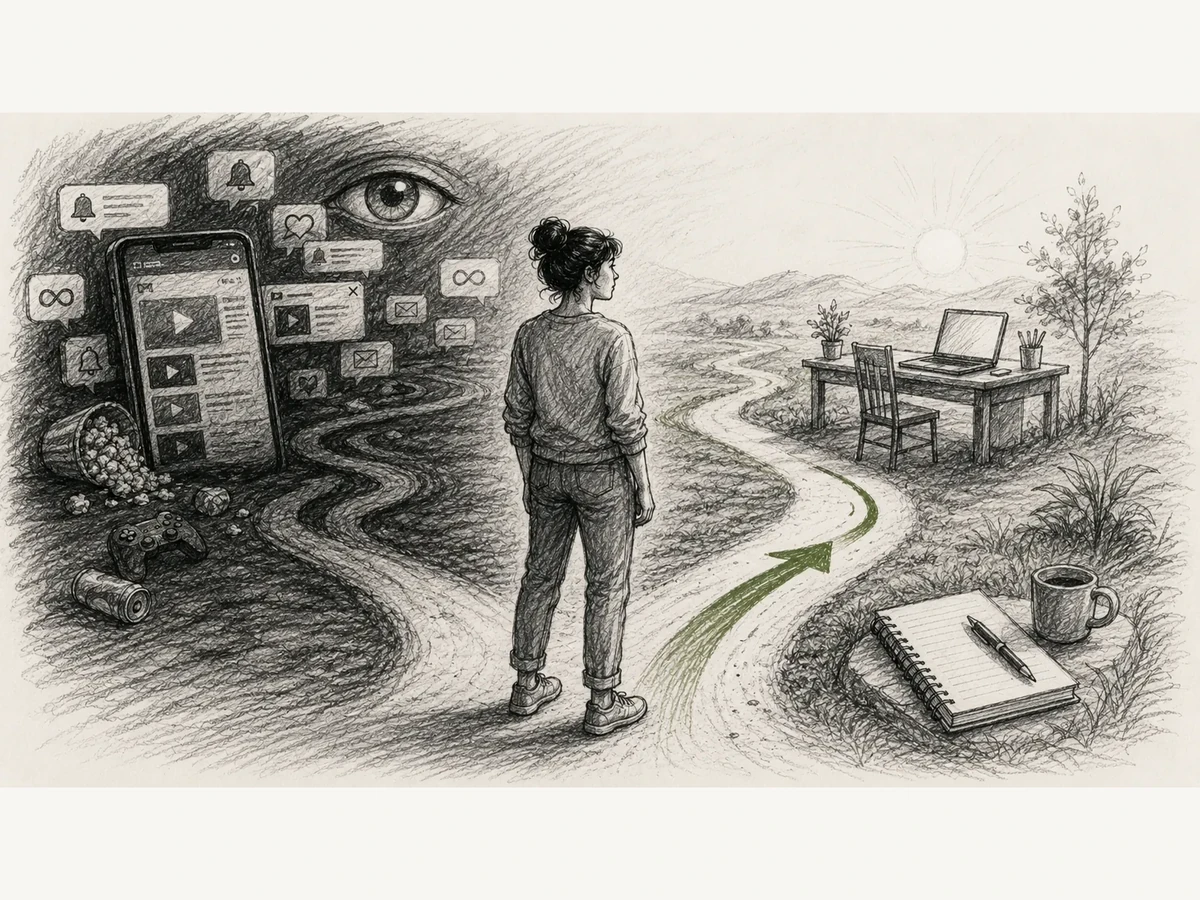
On many free platforms, a young adult's attention is the product. The user is what is being sold. Feeds, notifications, autoplay, streaks, and red badges are built to take as much of that attention as possible and give back as little as they can.
This is not a fair fight, and pretending it is — "just use willpower" — is useless advice. You do not out-willpower a machine designed by hundreds of people to beat your willpower.
What works is understanding the game and changing the board. Turn off the notifications. Kill the autoplay. Make the phone boring. Put it in another room. Build friction between yourself and the thing engineered to be frictionless.
The goal is not to reject technology. A young adult who throws the phone in a drawer and calls it virtue has not learned control; they have just run away. The goal is to be the one deciding — to pick up the tool, use it on purpose, and put it down when the using is done, instead of surfacing two hours later wondering where the evening went.
A person who can't direct their own attention does not fully own their own life. Everything else — work, relationships, learning, rest — runs through it.
What your digital trail reveals
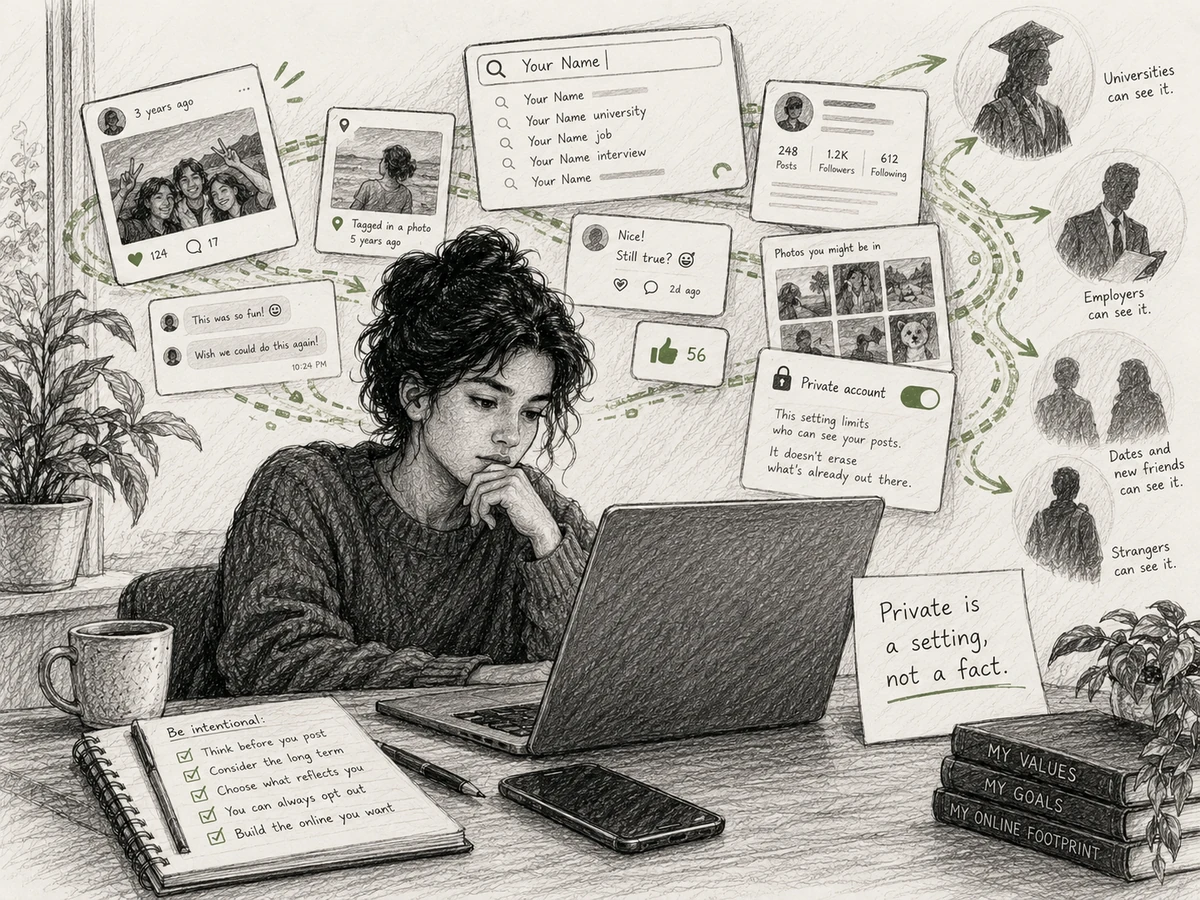
There is a second self a young adult is building, often without meaning to: the version of them that lives online. It is assembled out of what they post, what they like, the group-chat message that gets screenshotted, the photo a friend tags, the comment left at fifteen that is still searchable at twenty-five.
They do not fully control it, they cannot fully delete it, and other people — schools, employers, dates, strangers who decide they do not like them — will read it and draw conclusions long before meeting them in person.
This is not a reason to be afraid of being online. Hiding is its own failure; a young adult with no presence can be just as stuck as one with a reckless one. The goal is to be findable without being foolish.
Two things they should understand in their bones: "private" is a setting, not a fact — anything sent to anyone can be saved, forwarded, and surface years later — and the feed rewards the loudest, angriest, most performed version of a person, which is rarely the one they will want attached to their name later.
The standard is not "post nothing." It is to assume the trail is permanent and public, act accordingly, and still show up as a real person instead of a scared one.
What digital literacy isn't
This is not about turning every kid into a programmer. It is not screen-time panic, and it is not pretending technology is evil. The tools are not the enemy. Not understanding them is.
It is not about chasing every new platform, gadget, or app the moment it appears. The specific tools are temporary. The competence is permanent.
It is not about banning things — the phone, the games, the AI — and calling the absence a skill. A kid kept away from technology is not prepared for it; they are just unprepared later, with less supervision.
And it is not about fear. A young adult who is scared of technology is just as managed by it as one who is addicted to it. Both have handed over the controls.
The tools are powerful. That means use them. It also means don't let them use you.
Practice with real tools and real risks
Families don't need to become IT departments. They need to stop treating technology as either a babysitter or a boogeyman, and start treating it like what it is — a powerful tool a kid has to learn to operate.
Make them figure things out. When the device acts up, don't just fix it. Sit with them while they read the error, search the problem, and try the solution. The goal is a kid who troubleshoots, not a kid who hands you the phone.
Use AI in front of them, out loud. Show them the good answer and the confidently wrong one. Show them how you check it, how you push back, how you use it to get further instead of to skip the work. Let them watch an adult treat it as a tool and not an oracle.
Talk about the business model, plainly and more than once: many apps are free because attention and data are valuable. A kid who hears that out loud stops taking the bait personally.
Set the attention rules together, and follow them yourself. The parent scrolling through dinner has already lost the argument. Boundaries that the adults ignore teach the opposite lesson.
Make them make something with the tools, not just consume through them. A spreadsheet that does real math. A video that says something. A document that solves a problem. The line between using technology and being used by it often comes down to whether they ever create with it or only receive through it.
And let them be bored sometimes. Boredom is where attention comes back. A kid who never sits with an empty moment never learns that they can.
Talk about the trail before they leave one they regret. Not as a scare campaign — as a plain fact about how the world now works. Ask, before they post: would you be fine with this still being findable in ten years, by someone who is not on your side? A kid who learns to ask that themselves does not need you checking their accounts.
The goal is transfer: from a kid the technology manages to a young adult who manages the technology.
Can you use the tool without letting it use you?
The real test of Domain 9 is not whether a young adult can use a phone. Of course they can. That was never in question.
It is whether they can walk up to an unfamiliar tool and master it instead of waiting to be shown. Whether they can use AI to get sharper instead of softer. Whether they can be lied to by a screen — by a scammer, a feed, a confident fake — and catch it.
Whether they can feel the pull of the thing built to capture them, and put it down. Whether they can lose the technology entirely and still be fine. Whether the trail they leave is one they can stand behind.
And underneath all of it, one question: when they pick up tools that increasingly shape how people learn, communicate, and work, are they the one in charge — or is something on the other side of the glass quietly running them?
That's the point of Domain 9. Not being good with phones. Not coding. Not screen-time panic. Technology, media, and AI as tools they command — not masters they serve.
Where do you see young people confusing familiarity with an app and real digital competence? Tell me what you've seen. Examples that challenge this argument are welcome.