I Was Looking for Better Objections
I asked teachers to challenge LifeEducation. Their objections did not force a redesign, but they showed me what the public explanation still needed to answer.
I have been asking people to tell me what is wrong with LifeEducation. I don't mean that as the polite request for feedback people make when they're hoping to be praised. I'm looking for weaknesses, contradictions, unrealistic expectations, and places where my own history has distorted the design.
This system is intended for my children. I have years to test it before it becomes the center of how we prepare them for adulthood, which makes this the best possible time to discover that I'm wrong about something important. A serious objection now could save us from building years of work on a bad assumption.
That was why I was excited to discuss LifeEducation with other teachers. Educators work with children every day. They know how clean plans collapse when actual children touch them. They see the gap between adult intentions and student outcomes. I expected them to notice holes I had missed.
These were class discussions, not formal reviews. No one had spent months studying the framework, and no one owed me a complete critique of it. I wasn't expecting finished answers. I was hoping the questions would at least point toward the hardest parts of the design.
Mostly, they didn't.
The Objections I Was Hoping For
The LifeEducation Floor makes a large claim. It says there is a non-negotiable minimum set of capabilities a young person should demonstrate before adulthood is treated as real. That should be challenged hard.
Is eighteen the right deadline for every capability? Have I confused my own preferences with universal requirements? Are some expectations developmentally unrealistic, culturally narrow, or impossible to assess honestly? Could the Floor become another checklist young people learn to game?
The harder questions go beyond the list itself. Can we gather enough evidence to know whether capability is real without rebuilding school through constant documentation? Does control transfer to the young person quickly enough? What happens when a parent believes something is necessary and the young person fundamentally disagrees? Which abilities require sustained peer groups, institutions, or adults with expertise the family doesn't have?
I also wanted people to question me. Where might my anger at school be shaping the system more than I recognize? What evidence would persuade me that LifeEducation was failing? Am I protecting my children's independence, or building an elaborate structure around my own need to control the outcome?
Those are objections that could force a redesign.
The Objections I Actually Heard
Instead, I heard that some people liked school and found it useful. I heard that children need structure and socialization. Parents might lack time, expertise, rigor, or ideological balance. Disadvantaged children rely on services attached to schools. A system designed for one family might not scale.
None of those concerns is ridiculous. Some people did well in school, loved it, found important adults there, and built lives they value. Some children need a great deal of structure. Some rely on school for food, safety, disability services, dependable adults, community, or simply a predictable place to spend the day. Parents can be controlling, misinformed, ideological, disorganized, or overwhelmed.
Those are real concerns. They just aren't the same as testing LifeEducation.
One teacher said he liked school and didn't think it was all that bad. I believe him. School probably worked reasonably well for him. He understood its rules, earned the credentials he needed, and eventually built a life inside the same institution.
That comment was one person's experience, not a complete defense of public education, and I don't want to make it carry more than he intended. The limit of the argument is simply that personal satisfaction can't establish that school is a good default design for childhood. A system can't prove its adequacy by pointing to the people who fit it best.
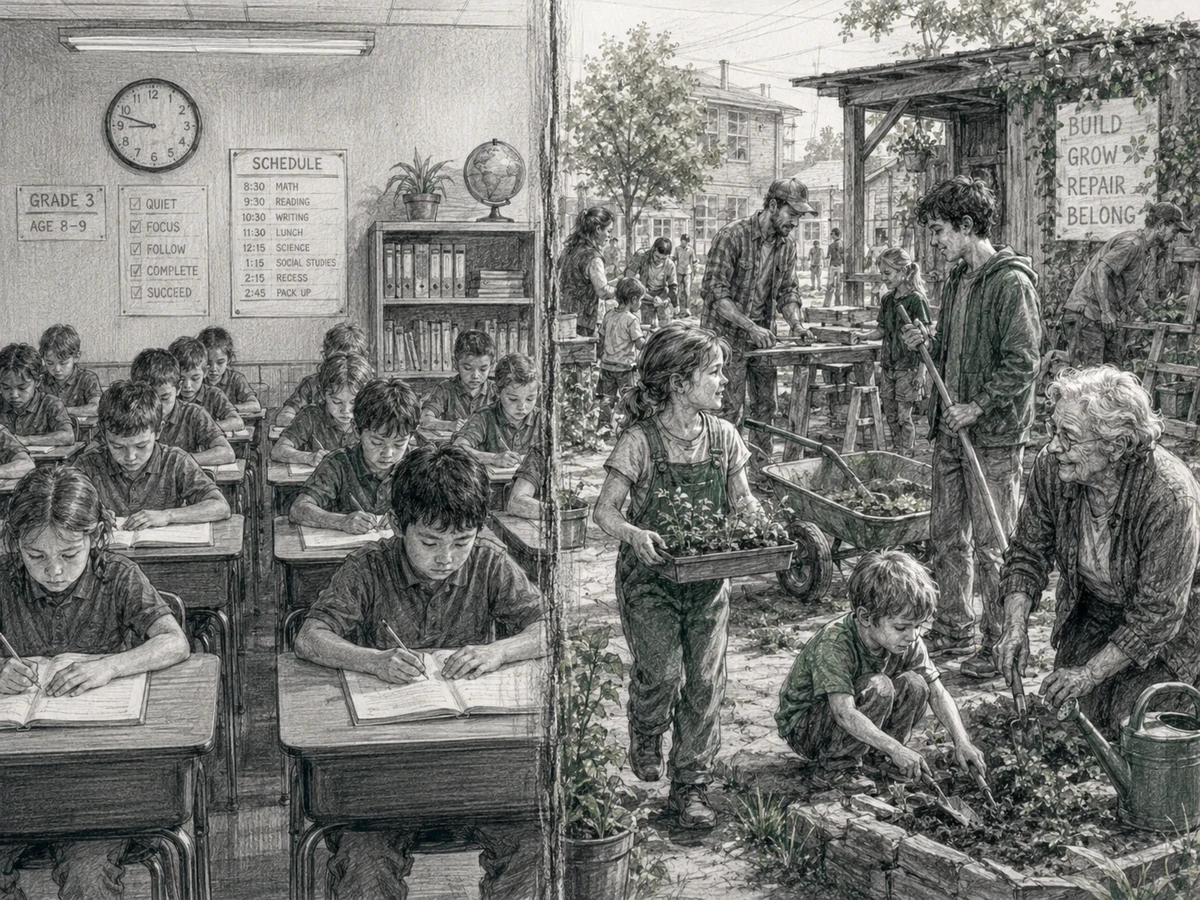
The other objections followed a similar pattern. "Some children need structure" is true, but it doesn't automatically justify bells, age batching, fragmented subjects, permission-based movement, constant grading, six or seven simultaneous classes, and adult-controlled pacing. Structure and school aren't synonyms.
"Children need socialization" is also true, but school is not the only place where children encounter other people. Sports, work, neighbors, extended family, community groups, projects, travel, clubs, and ordinary life can provide a broader range of ages and relationships than an age-segregated building.
"Parents might teach misinformation" is a serious concern, but schools transmit beliefs too. The real question is whether a young person learns to compare claims, examine evidence, encounter serious alternatives, and eventually reject the adults' conclusions when the evidence requires it.
"Not every family can do this" may be the strongest practical objection. Most families can't simply replace school under current work, housing, transportation, childcare, and income arrangements. My family currently depends on the custodial function of school too. That is an argument against pretending LifeEducation can become an immediate universal replacement. It isn't an argument that the current education is good enough.
What the Feedback Was Actually Good For
The conversations did not expose a fatal flaw in the Floor, the evidence model, or the transfer of responsibility. They did expose something useful: I had not made several distinctions clearly enough for an ordinary reader encountering LifeEducation for the first time.
That led me to expand the public Q&A. It now answers questions including:
- Are you saying school never helps anyone?
- Would you use a great school?
- Don't some kids need structure?
- What about kids who feel safe inside school structure?
- What about disadvantaged kids?
- Isn't equity the reason we need standardized schooling?
- How does neurodiversity fit into this?
- Can LifeEducation scale?
- Are you attacking teachers?
Those questions matter because they show where readers are likely to misunderstand the project. LifeEducation isn't anti-learning, anti-teacher, anti-structure, or anti-serious study. It doesn't claim that school never helps anyone or that every family can leave tomorrow. It does claim that school is one possible environment, not the operating system and not the default authority over childhood and learning. A school has to prove that it builds capability; it doesn't get automatic trust because it's official.
It also claims that support should change the route without abandoning the destination. A child may need more time, more structure, direct instruction, tutoring, therapy, assistive technology, translation, quieter spaces, or outside expertise. None of that requires pretending capability exists when it doesn't.
The objections helped me say those things more plainly.
I Am Still Looking
LifeEducation isn't a finished product that another family can purchase and install. It's a framework being built for my children, documented publicly, tested against reality, and revised when the evidence requires it. I'm not asking people to agree with it, and I'm not pretending our implementation will work unchanged for everyone else.
The objections I received did not make me rebuild LifeEducation. They did make me explain it better. That matters.
If you see the weakness I haven't, send it to me. Tell me which capability is missing, which requirement can't be justified, where the evidence model will distort behavior, or where parent authority will last too long.
But I am still looking for the objection that forces me to change the design.